Choosing the best Bouncy House Slide in 2026 requires more than bright colors and impressive height. Global buyers need evidence, testing, and practical operating details.
Market research shows why this category deserves careful evaluation. Grand View Research identifies continued growth in the global inflatable toys market, supported by family entertainment venues, rental businesses, and private celebrations. Fortune Business Insights also reports rising demand for interactive recreational products, especially those combining physical activity with social play. These reports describe market direction, not product quality. That distinction matters.
Safety comes first.
A reliable Bouncy House Slide should reflect recognized guidance, including ASTM F2374 for inflatable amusement devices and applicable local requirements. Buyers should request material specifications, seam-testing information, blower details, anchoring instructions, and inspection records. A professional supplier should explain these documents clearly, rather than hiding behind attractive product photographs.
Real-world use exposes weaknesses. A slide may look stable indoors but shift on uneven grass. A compact model may suit a home garden but frustrate a busy rental operator. Rain, wind, storage temperature, user age, and daily cleaning can change performance. These details deserve more attention than novelty graphics.
This guide compares 2026 options through durability, safety features, setup time, capacity, maintenance, shipping practicality, and after-sales support. It also considers buyer experience across climates and business models. No ranking is perfect. Supplier claims still require verification. That is an uncomfortable, necessary point. A responsible purchase balances enjoyment, documented performance, and long-term operating cost.
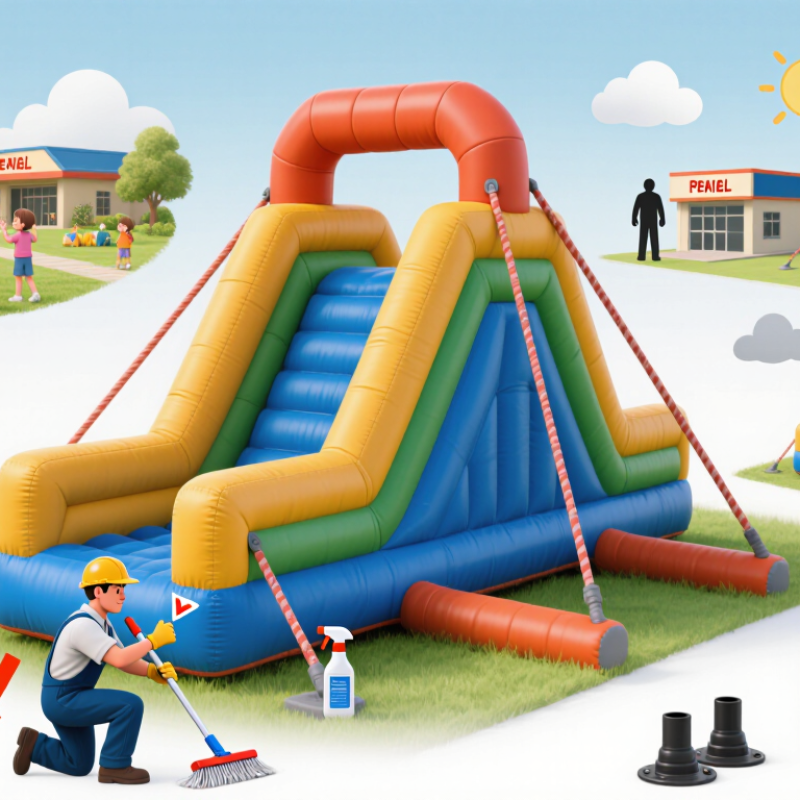
2026 Best Bouncy House Slide for Global Buyers?
What Defines a High-Quality Bouncy House Slide in 2026
A high-quality bouncy house slide starts with materials that suit repeated commercial use. Reinforced PVC should feel flexible, thick, and evenly coated. Seams need clean stitching, strong welding, and no exposed thread. Small defects matter. A practical inspection should check the climbing steps, slide lane, landing zone, and attachment points. These areas receive the most stress during busy sessions.
Safety depends on more than attractive colors. Stable anchoring, balanced air pressure, protective side walls, and a soft landing area are essential. The blower should maintain steady airflow without excessive noise or heat. Clear weight limits and user instructions should be visible. Operators also need training for setup, supervision, weather decisions, and emergency deflation. No inflatable remains maintenance-free. That expectation needs correction.
Reliable suppliers should provide material details, repair guidance, inspection records, and documentation for applicable regional requirements. Independent testing can strengthen confidence, but buyers should check what each test actually covers. A certificate alone does not prove long-term durability. Ask for production photos, seam samples, warranty terms, and spare-part availability. User feedback is useful when it describes months of operation, not just delivery day. I would also inspect a slightly used unit when possible. It may reveal fading, stretching, or landing-zone wear that polished photographs hide.
| Quality Dimension | Recommended 2026 Benchmark | Why It Matters to Global Buyers | How to Verify |
|---|---|---|---|
| Material Strength | Commercial-grade PVC-coated fabric, commonly around 0.55–0.70 mm, with reinforced stress points. | Improves resistance to abrasion, repeated inflation, outdoor exposure, and frequent commercial use. | Request material specifications, coating details, seam samples, and abrasion or tensile-test documentation. |
| Slide Surface | Smooth, continuous sliding lane with secure side walls, a stable landing area, and no exposed hard edges. | Supports predictable sliding and helps reduce contact with seams, fasteners, or structural components. | Inspect finished photos, sample units, transition points, landing zones, and user-contact areas. |
| Safety Walls and Guardrails | Raised side walls, enclosed climbing sections where appropriate, and padded barriers at elevated platforms. | Helps limit falls from elevated areas and provides clearer separation between climbing and sliding zones. | Check design drawings, barrier heights, padding coverage, access openings, and applicable local requirements. |
| Anchoring System | Multiple dedicated anchor points positioned according to the structure design and intended operating surface. | Proper anchoring helps resist movement, tipping, and wind-related instability during operation. | Confirm anchor layout, compatible stakes or ballast, installation instructions, and wind operating limits. |
| Inflation Performance | Stable operating pressure with properly sized commercial blowers and limited air leakage at seams. | Consistent inflation supports structural firmness, user comfort, and efficient daily operation. | Review blower specifications, electrical requirements, inflation time, pressure behavior, and leak-check results. |
| Blower and Electrical Compatibility | Electrical configuration clearly stated for the destination market, including voltage, frequency, plug, and protection requirements. | Reduces installation delays and helps buyers select equipment compatible with local power systems. | Verify rating labels, user manuals, plug type, residual-current protection guidance, and conformity documents. |
| Load Capacity | Clearly stated maximum user weight, maximum number of users, and separate limits for climbing and sliding areas. | Clear limits help operators manage mixed-age users and prevent overloading or unsafe congestion. | Check the permanent safety label, operating manual, test report, and product-specific capacity calculation. |
| Age and Height Guidance | Separate operating guidance for children of different sizes, with visible rules for age, height, and simultaneous use. | Helps operators match users with suitable play zones and reduce collisions between significantly different sizes. | Review labels, supervision instructions, entry controls, and local amusement-equipment guidance. |
| Seams and Reinforcement | Even, durable stitching or welding with reinforced corners, handles, anchor points, platform edges, and high-load transitions. | Stress areas experience repeated loading and are common locations for premature wear or air leakage. | Inspect seam consistency and request production quality-control records or independent test evidence. |
| Ventilation and Visibility | Adequate mesh panels or viewing areas where enclosure is used, without creating unsafe openings or climbable gaps. | Supports airflow, supervision, heat management, and visibility for attendants. | Check mesh strength, opening dimensions, visibility from the operator position, and ventilation design. |
| Surface and Weather Resistance | Fabric and printing suitable for the stated indoor or outdoor environment, with UV, moisture, and cleaning considerations documented. | Important for regions with strong sunlight, high humidity, rain, dust, or large temperature changes. | Request care instructions, UV and colorfastness information, drainage details, and environmental limitations. |
| Cleaning and Hygiene | Non-porous, wipe-clean contact surfaces with documented cleaning, drying, inspection, and storage procedures. | Frequent cleaning reduces dirt accumulation and helps maintain safe, presentable equipment for repeated public use. | Review approved cleaning agents, drying requirements, mildew prevention, and maintenance checklists. |
| Inspection and Maintenance | Daily pre-use checks, scheduled detailed inspections, repair records, and clear retirement criteria. | A documented maintenance system helps identify damage before it affects users or interrupts operations. | Request inspection forms, repair procedures, spare-part availability, and service response information. |
| Transport and Storage | Compact rolled or folded configuration with stated packed dimensions, weight, protective bag, and moisture-control guidance. | Affects freight cost, warehouse space, handling labor, and protection during international transportation. | Confirm packed dimensions, gross weight, packaging list, lifting requirements, and storage conditions. |
| Documentation and Compliance | Complete user manual, risk information, safety labels, material details, inspection guidance, and destination-market documentation. | Requirements vary by country, venue, and intended use; accurate documentation supports safer deployment and buyer due diligence. | Compare documents with the exact model, applicable standards, importer requirements, and local authority expectations. |
| Warranty and Spare Parts | Written coverage for fabric, seams, blowers, and workmanship, plus access to compatible repair materials and replacement parts. | Reliable after-sales support can reduce downtime and extend the usable life of commercial equipment. | Check warranty exclusions, claim procedures, response times, repair kits, and long-term parts availability. |
Buyer note: The benchmarks above are general purchasing guidelines. Final suitability should be confirmed against the exact product design, intended users, operating environment, and regulations in the destination market.
A straight slide usually needs less space and offers simpler supervision. Measure the landing zone carefully. Compact does not mean risk-free.
Dual lanes can shorten waiting times during busy events. They support supervised racing between users. Each lane still needs a clear exit area.
Check fabric weight, reinforced seams, mesh visibility, anchor points, and load limits. Bright colors prove very little. Ask for inspection records.
Measure its inflated footprint, entry height, and landing clearance. Keep extra room around the sides. A narrow gate may block delivery.
Look for soft landing zones, enclosed climbing sides, high mesh walls, and multiple anchor points. Protective blower covers also matter. Small gaps can matter.
Hot, humid locations need UV-resistant fabric, sealed seams, and drainage points. Cold areas need flexible materials that resist cracking. Local conditions can change quickly.
Confirm voltage, plug type, frequency, and blower power before ordering. An unsuitable blower can delay installation. Regional electrical advice may prevent costly mistakes.
Record gross weight, carton dimensions, customs documents, and delivery responsibility. Confirm packaging protection and spare-part availability. Assumptions often cause trouble.
No. Photos may hide weak stitching, repeated-use wear, or unstable corners. Request recent testing evidence and inspect the unit after trial setup.
No checklist catches everything. Operators should inspect anchors, air pressure, seams, exits, and weather conditions before opening. My judgment can still miss hidden wear.
Choosing the best Bouncy House Slide in 2026 requires more than comparing colors or prices. A high-quality product should combine durable, weather-resistant materials with stable construction, smooth seams, reliable anchoring points, and a design suited to its intended age group and activity level. Buyers should compare slide height, climbing areas, landing zones, bounce space, theme, capacity, and portability to find the right balance between entertainment and practicality. Safety features are especially important, including secure entrances, protective side walls, reinforced stress areas, clear user guidance, and effective airflow or inflation systems.
Materials, dimensions, setup time, storage requirements, and maintenance needs can strongly affect the total value of a Bouncy House Slide. International buyers should also confirm product specifications, packaging, shipping conditions, included accessories, warranty terms, installation instructions, replacement-part availability, and applicable safety documentation before ordering. Careful evaluation helps buyers select a dependable, age-appropriate, and easy-to-manage inflatable attraction for different markets and operating environments.

 Huayue Toys